TOMOSYNTHESIS
CE-marked (EU MDR Class IIb)
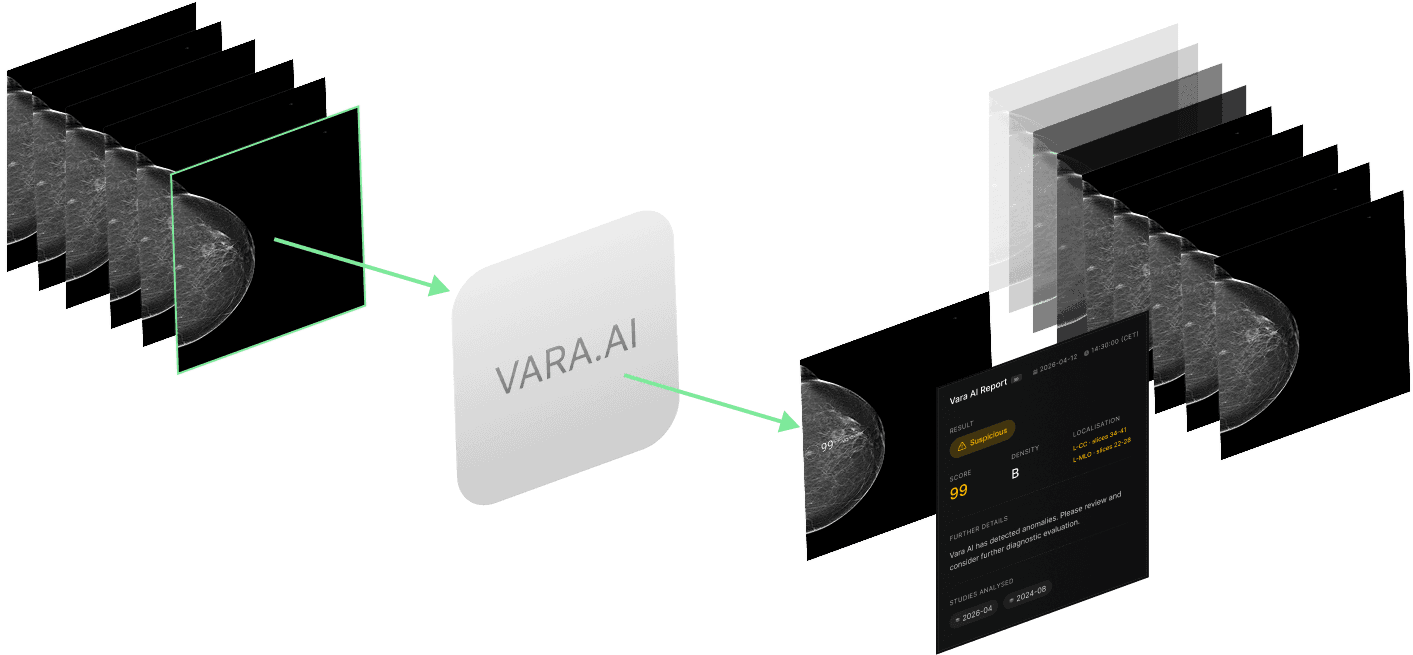
One AI report, extended across every level of your tomosynthesis data: synthetic 2D, slabs, and the complete 3D stack.
WHY TOMOSYNTHESIS AI
More detection, without more reading time
Tomosynthesis improves cancer detection, especially in dense breasts — but it multiplies the reading workload per exam. Programs already short on radiologists can't absorb that volume unsupported.
Vara's tomo AI works the way our mammography AI already does: it sits inside your existing PACS, reads as a concurrent or independent second reader, and adds no steps for the radiologist — helping programs hold reading quality at the volume they actually operate at.
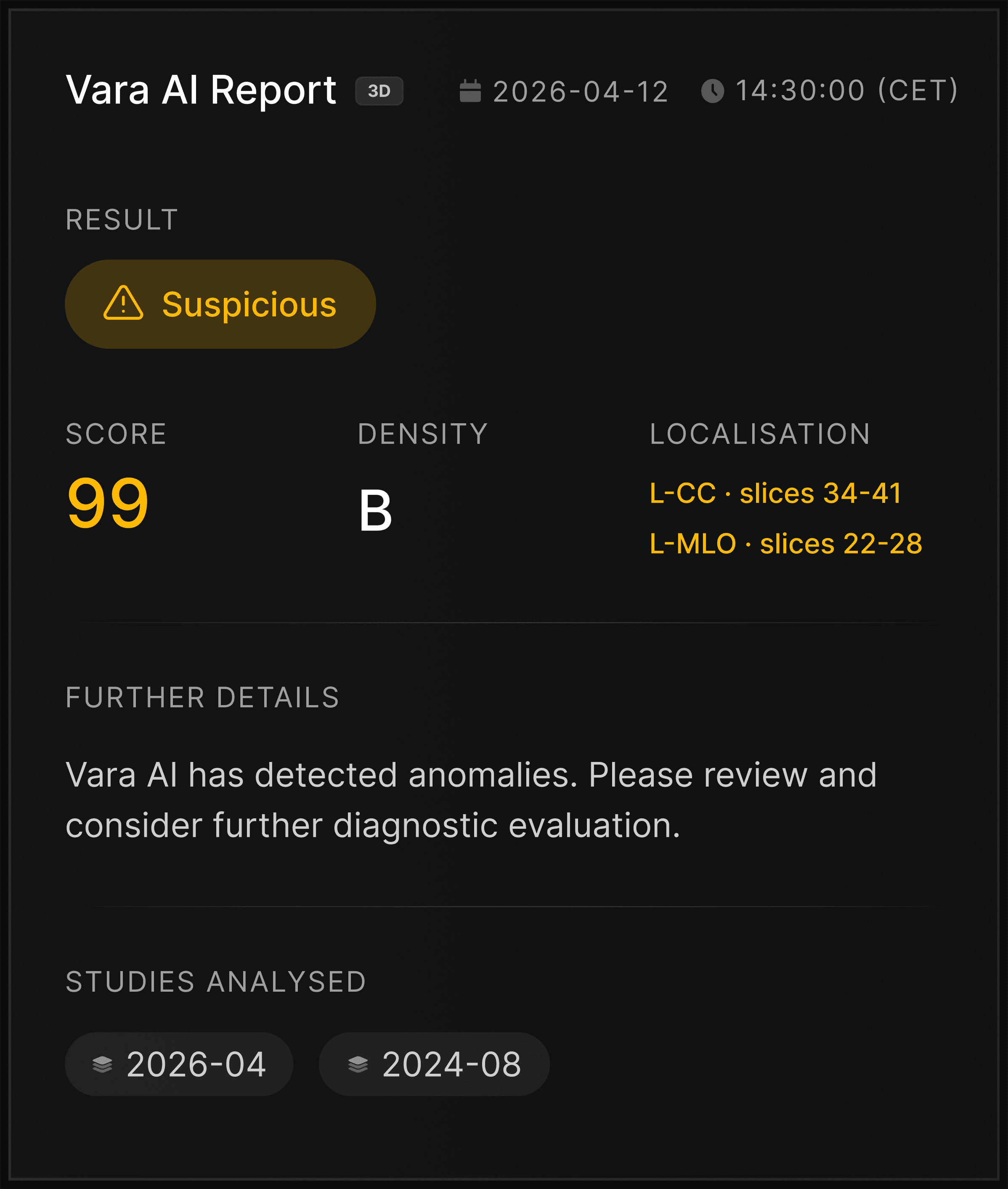
CAD-SR
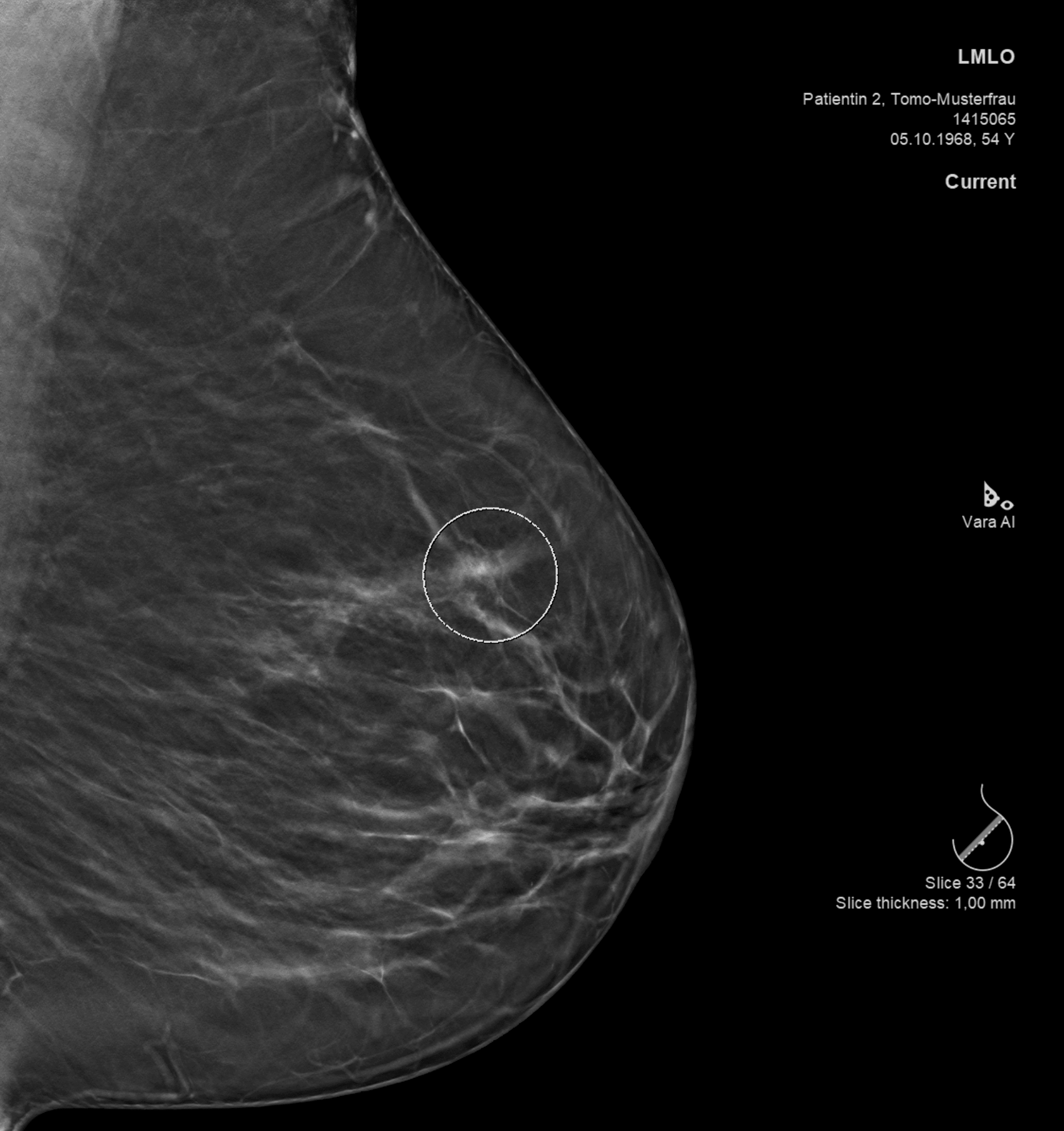
Vara shows you where to look
A region-of-interest marking points the radiologist straight to the finding — a focus map before scrolling through the 3D stack.
The marking gets more precise as more of the study is analysed: from the synthetic 2D view, to a slab, to the individual 3D slice being read.
ONE REPORT
Every level of your tomosynthesis study
Whether your site sends synthetic 2D, slabs, or the full 3D tomosynthesis stack — Vara analyses what is received and delivers the same structured AI report. With more slices, localisation becomes more precise.
The same Vara foundation, at every level
" transform="translate(8 10)" width="8px"/><path d="M 8 0 C 12.418 0 16 3.582 16 8 C 16 12.418 12.418 16 8 16 C 3.582 16 0 12.418 0 8 C 0 3.582 3.582 0 8 0 Z" fill="transparent" height="16px" id="bljcLVuwO" stroke-dasharray="0" stroke-linecap="butt" stroke-linejoin="miter" stroke-miterlimit="4" stroke-width="2" stroke="rgb(255, 255, 255)" transform="translate(4 4)" width="16px"/></svg>)
No new infrastructure required at the site
The same proven Vara report radiologists already trust
DEPLOYMENT
Cloud or on-premise
Cloud — Default
Vara runs in the cloud by default — minimal data to move for S2D, scaling up to the full stack, with monitoring and analytics included.
On-premise — For Partnerships
For partnerships where data cannot leave the premises, the full 3D solution can be deployed entirely on your own infrastructure — the same analysis, nothing leaves the site.
No new infrastructure required at the site